Blog:
When are gel batteries the right thing?
Five years ago you could still walk into a chandlery or caravan shop and see little more than flooded and AGM batteries. Today, lithium dominates brochures and product listings. It offers high power, fast charging and impressive cycle life.
But the real engineering discussion needs to be centred around what’s right for the application in question. Gel batteries still belong in that discussion. They should not be treated as a fallback when lithium is unavailable but as a deliberate choice in specific conditions.
This article explains where gel batteries excel, how they differ from AGM and lithium and why the whole system design must drive the decision.

What makes a battery a “gel” battery?
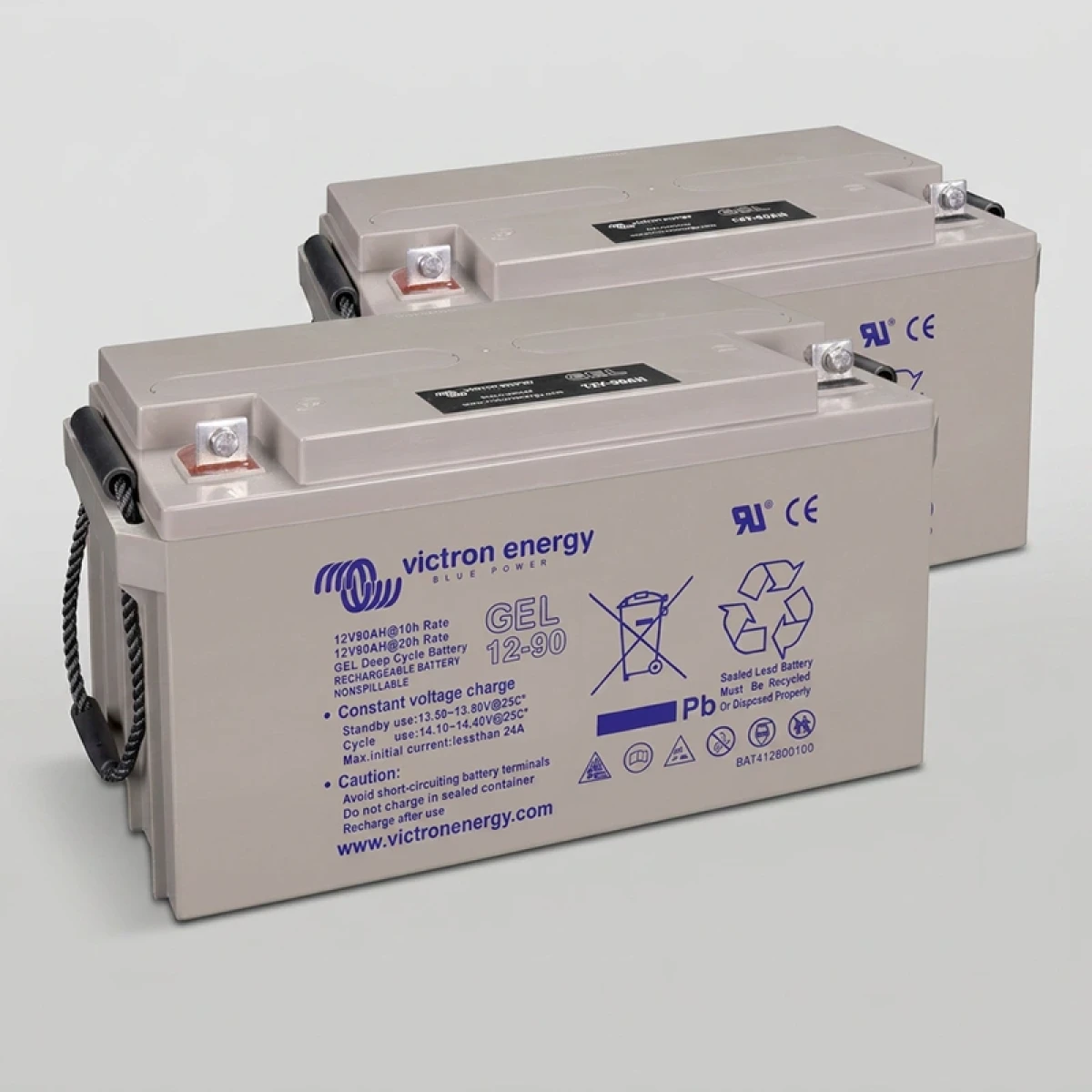
Gel batteries are a type of sealed lead acid battery. Rather than liquid electrolyte, their sulphuric acid is locked in a silica based gel, producing a sealed, non spillable unit.
This construction allows gel batteries to operate in almost any orientation, requires significantly less ventilation than flooded batteries during normal operation, provides excellent vibration resistance and eliminates the need for routine maintenance. The downside is that the gelled electrolyte results in higher internal resistance than AGM batteries, limiting both charging current and high-current discharge capability.
The upside is they are better suited to repeated deep cycling than most AGM batteries.
Application driven battery selection
It is tempting to treat batteries as a hierarchy with lithium at the top because of its high energy density and rapid charging. In reality each chemistry suits a different job.
AGM batteries, another VRLA design, hold their electrolyte in a glass mat and excel at delivering short high current bursts. Gel batteries, by contrast, favour steady deep cycle work. Their slower charging and discharging characteristics mean they thrive when loads are predictable and charge sources are modest.
Although elevated temperatures reduce the service life of all lead-acid batteries, Victron's published data shows that its gel batteries retain a longer design service life than comparable AGM batteries at 30°C and 40°C. Lithium is unmatched for weight sensitive or high power systems but it requires careful management and costs more. In other words, battery choice is an engineering judgement, not a race to adopt the newest technology.
Where gel batteries excel
Several real world situations play to gel batteries’ strengths. Solar supported cabins and welfare units are an obvious example. A solar array trickles energy into a battery bank over many hours; gel batteries are designed to accept that slow, controlled charge.
Manufacturers advise that a proper full charge from deep discharge takes several hours and should not be rushed. In return, gel cells offer stable, deep cycle storage when charge sources are modest and intermittent.
Marine and RV installations also benefit. Boats and caravans experience vibration, heat and occasional deep discharges – a sealed gel battery can withstand those conditions and produces very little gas during normal operation, reducing corrosion.
Mobility devices such as electric wheelchairs similarly value gel’s long cycle life over high discharge current. Remote telecommunications sites and sensors that draw small but steady loads can also rely on gel batteries’ low self discharge and long design life. A gel bank left idle over winter retains most of its charge for the following season.

Charging behaviour and system design
Because the chemical reaction in gel batteries is slower, the way you charge them matters.
A 12 V gel battery normally needs a bulk/absorption voltage around 14.1–14.4 V. Pushing higher voltages or trying to recharge quickly can create gas pockets within the gel and permanently reduce capacity.
Manufacturers emphasise a proper charge cycle takes time and that chargers should taper current appropriately. This makes gel batteries unsuitable for high surge or rapid charge installations.
If your system has a large inverter, electric winches or other high current loads, AGM or lithium batteries will perform better because they can accept high charge rates and deliver high current.
Another design consideration is ensuring the charger and controller match the chemistry. Many smart chargers have settings for gel, AGM and lithium. Using the wrong profile can either dry out a gel battery or undercharge an AGM. Battery selection therefore includes matching the charging hardware and overall system design.
Gel vs. AGM vs. lithium in brief
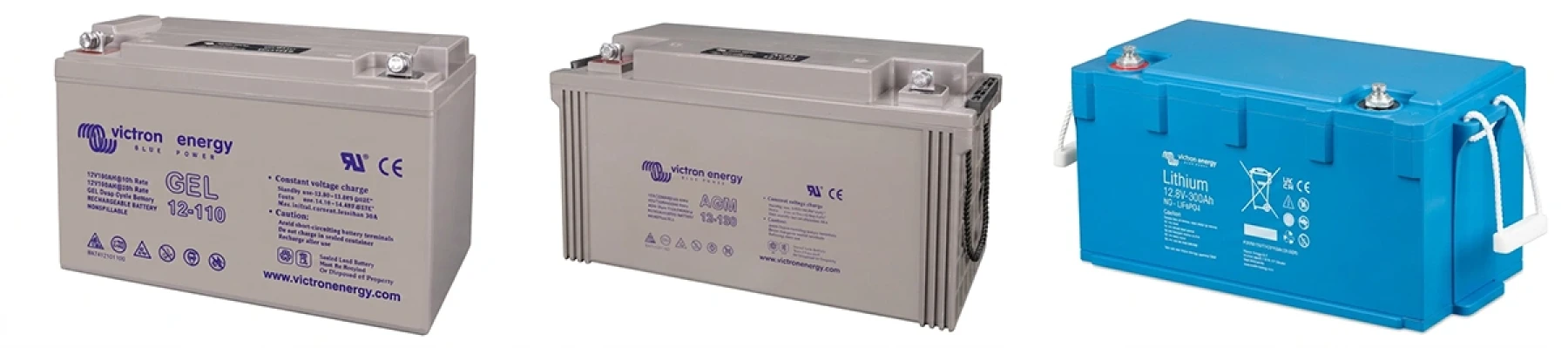
No single battery chemistry wins on every metric. AGM batteries are the go to for high current discharge because their internal resistance is low. Gel batteries sacrifice surge performance but return better deep cycle endurance and longer service life – Victron quotes a 12 year design life for its gel range compared with 7–10 years for its AGM units.
Lithium cells support high discharge rates and thousands of cycles but they cost more up front and require sophisticated management. All three are sealed and maintenance free but their charging requirements differ: gel batteries need lower voltage and slower, tapered charging; AGM batteries use a different charging profile from gel batteries and are compatible with most modern smart chargers offering an AGM mode. Lithium batteries require a charger designed for lithium chemistry and rely on a battery management system (BMS) to protect the cells and ensure safe operation.
In cost terms, gel sits between AGM and lithium. It costs more than standard flooded or AGM units but less than a comparable lithium pack, while offering durability and resilience in harsh conditions.
Frequently asked questions about gel batteries
When are gel batteries better than lithium batteries?
Gel batteries can be the better choice when charging is slower and more gradual, when loads are relatively steady and where rugged reliability matters more than maximum power density. They are often well suited to solar-supported off-grid systems, marine house banks, mobility applications and remote installations where predictable deep cycling is more important than rapid charging.
Are gel batteries good for solar systems?
Yes. Gel batteries are often a strong fit for solar-supported systems because they are comfortable with slower charging profiles and repeated deep cycling. In remote cabins, welfare units and off-grid properties where solar input changes throughout the day, gel batteries can provide stable and dependable storage when properly configured.
What is the difference between gel and AGM batteries?
Both are sealed lead-acid batteries but behave differently. AGM batteries are generally better at delivering high bursts of current and handling heavy inverter loads, while gel batteries are typically better suited to slower, steadier deep-cycle applications. Gel batteries also tend to tolerate deeper discharge better than AGM batteries.
Why are gel batteries slower to charge?
Gel batteries use a gelled electrolyte. this limits ion movement compared with AGM batteries, reducing acceptable charging currents. That slower reaction is one of the reasons they perform well in controlled deep-cycle applications but it also means they should not be aggressively fast-charged.
Can gel batteries be used in marine applications?
Absolutely. Gel batteries are widely used in marine environments because they are sealed, vibration-resistant and maintenance-free. They are particularly useful for house banks and auxiliary systems where reliable long-duration power is more important than high-current bursts.
Are gel batteries maintenance-free?
Yes. Gel batteries are sealed batteries, so they do not require topping up with water like traditional flooded lead-acid batteries. They also produce very little gas under normal operation, which helps reduce corrosion around terminals and electrical compartments.
What are the disadvantages of gel batteries?
Gel batteries are generally not ideal for:
- • High-current applications.
- • Rapid charging.
- • Weight-sensitive installations.
- • Systems requiring maximum energy density.
They also require carefully controlled charging voltages. Using the wrong charger settings can shorten battery life.
Are lithium batteries always better than gel batteries?
No. Lithium batteries are excellent in many applications, particularly where weight, charging speed and high usable capacity matter. But they are not automatically the right choice for every installation. Good battery selection is about matching the chemistry to the application rather than assuming newer technology is always best.
How long do gel batteries last?
A well-maintained gel battery can last many years. Victron, for example, quotes a design life of up to 12 years for some gel battery ranges, depending on operating conditions, charge management and depth of discharge.
Can gel batteries handle deep discharge?
Yes. One of the strengths of gel batteries is their tolerance for deeper discharge compared with other lead-acid battery types. That makes them useful in applications where batteries are regularly cycled rather than kept permanently topped up.
What charging voltage should a gel battery use?
Most 12V gel batteries require charging voltages around 14.1–14.4V during bulk and absorption charging, depending on manufacturer specifications. It is important to follow the battery manufacturer’s guidance and use the correct charger profile.
Are gel batteries still relevant today?
Yes. While lithium batteries dominate much of the market conversation, gel batteries remain highly relevant in applications where slower charging, deep-cycle durability, low maintenance and rugged reliability are priorities.
When gel batteries are not the right choice
There are also scenarios where gel batteries simply do not fit. High surge loads – starting engines, powering winches or driving large inverters – demand the low resistance of AGM or the high performance of lithium. Systems that must recharge rapidly between heavy discharges, such as rental equipment or high throughput storage, benefit from lithium’s fast charging. Weight sensitive installations, whether in electric propulsion or portable power packs, lean toward lithium because of its energy density. And when space is limited but capacity requirements are high, gel’s lower energy density can be a disadvantage. Recognising these limits prevents false economies: a “cheaper” gel battery may cost more in the long run if it is the wrong tool.
Why gel batteries still matter in off-grid solar and remote power systems
At Energy Solutions, battery selection is driven by application, not trends. While lithium technologies dominate many conversations around energy storage, there are still environments where gel batteries remain the smarter engineering choice.
As Tom Holland, Energy Solutions’ Customer Acquisition Manager, explains: “Gel batteries shouldn’t be seen as a fallback option. In the right application, they’re still absolutely the right technology.”
Different battery chemistries behave differently under different charging conditions, usage patterns and environmental demands. In remote solar-supported systems, for example, charging can often be slower and less predictable than in generator-led or grid-connected environments.
Gel batteries are particularly well suited to these conditions because of their tolerance for slower charge rates and repeated deep cycling.
Rather than forcing every project toward lithium, Energy Solutions focuses on specifying the battery technology that best fits the real-world operating environment. That may be gel, AGM or lithium depending on the demands of the system, expected usage patterns and long-term reliability requirements.
This practical, engineering-led approach is especially important in sectors such as marine, off-grid residential, construction and specialist vehicles, where reliability matters far more than following technology trends.
For customers operating in demanding environments, the priority is simple: dependable power, predictable performance and systems designed to last. Sometimes, gel batteries remain one of the best tools for delivering exactly that.
Conclusion
Lithium has rightly captured the spotlight in recent years, but it is not a universal solution. Gel batteries deliver slow and steady deep cycle performance, long design life and resilience in harsh conditions.
They thrive in systems where charging is controlled and predictable – solar arrays, off grid telecoms, marine house banks and mobility devices. Their slower charge acceptance and lower surge capability make them unsuited to high power or rapid charge environments, while AGM batteries cover high current loads at moderate cost and lithium excels where weight and performance are critical.
The point is not to rank technologies but to select the right chemistry for each job. When the application suits, gel remains the right choice and not merely a fallback.
Sign up to our mailing list
Keep up to date with the latest news and offers.

|
Thank you for Signing Up |


Submitting your details indicates that you have read and agree to our privacy policy and cookie policy. You can unsubscribe from our emails by using the link at the bottom of all emails we send.